

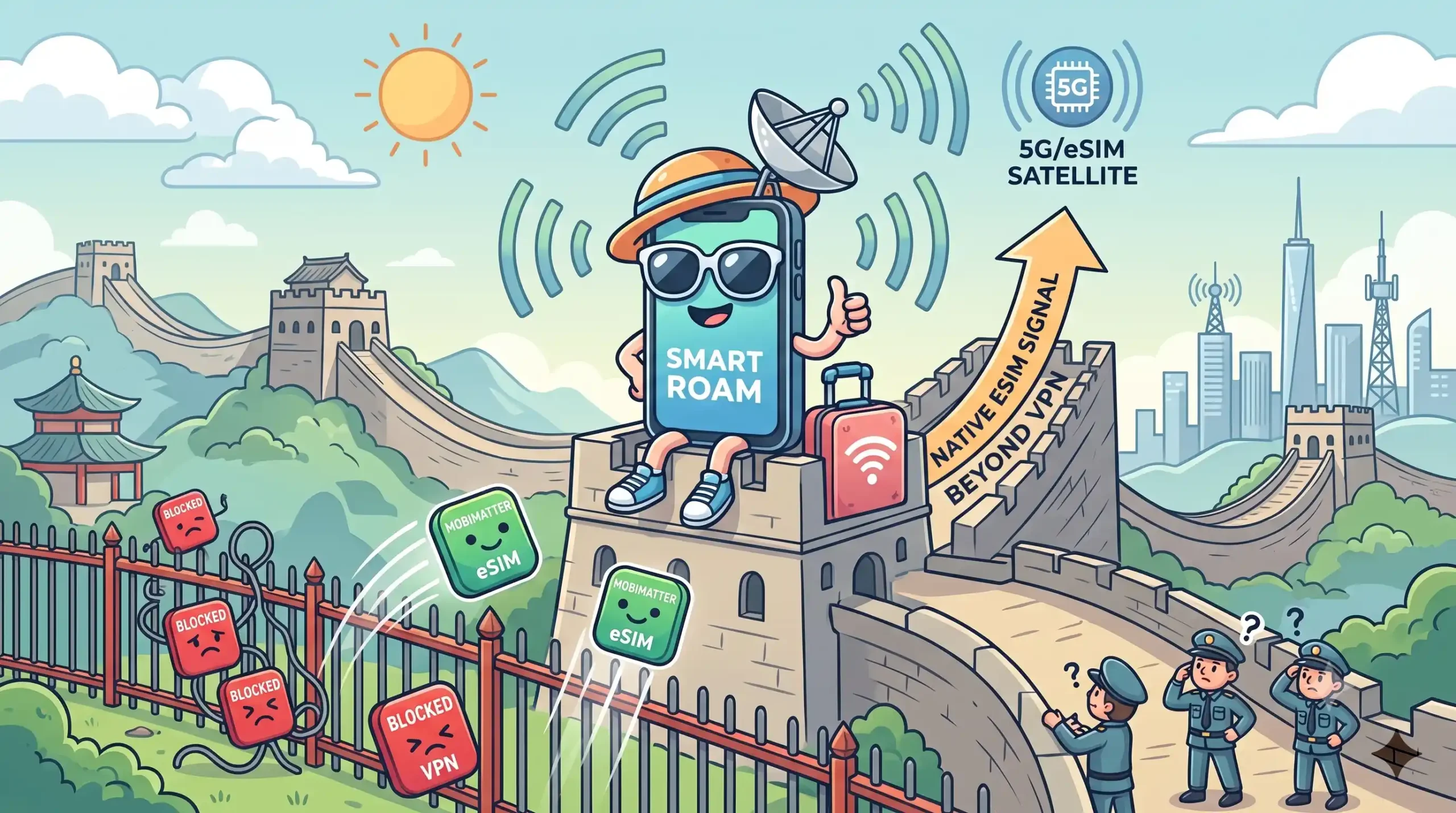
If you are planning a trip to China, relying solely on a traditional VPN is no longer a viable plan. Heightened Deep Packet Inspection (DPI) enforcement and persistent IP blocks have made consumer VPN apps notoriously unstable across mainland networks.
SMARTROAM
The Great Firewall Upgrade: Why VPNs Are Failing
Chinese authorities continuously tighten cross-border data inspection. The Ministry of Industry and Information Technology (MIIT) routinely targets unauthorized commercial VPN protocols, leading to frequent IP blacklisting and physical disconnects at domestic exchange points.
For foreign travelers, business professionals, and expats, this creates a major bottleneck. Standard VPN software often connects for a few minutes before dropping, leaving you unable to access Google Maps, WhatsApp, Gmail, or your corporate email.
The Solution: Hardware-Level Routing via Travel eSIM
While local software-based VPNs are being blocked, roaming data traffic operates under international telecommunication agreements. When you use a travel eSIM in China, your data is not routed through local Chinese internet service providers. Instead, it is tunneled through foreign gateway servers located in places like Hong Kong or Singapore.
Traveling with Family or Multiple Devices?
Tethering your laptop or buying four separate phone eSIMs drains batteries and runs up costs. The Linklan LA7 Open Pocket Wi-Fi connects up to 16 devices on an independent 5,000mAh battery (12+ hours runtime) using any low-cost travel eSIM profile.
This means your connection bypasses the Great Firewall naturally at the network level. You do not need to turn on a VPN app, re-connect repeatedly, or worry about app store bans.
Traditional App VPN
- High chance of server blocks during crackdowns
- Drains smartphone battery quickly
- Requires downloading before entering China
MobiMatter Travel eSIM
- Bypasses firewall via international roaming
- Native OS integration (zero battery drain)
- Instant digital delivery via QR Code
Recommended MobiMatter China eSIM Plans
MobiMatter provides some of the most reliable and cost-effective data bundles for China. Here are the top picks for different travel durations:
| Plan Name | Data Allowance | Validity | Price (USD) | Best For |
|---|---|---|---|---|
| China Short Trip | 3 GB | 5 Days | $3.99 | Short Business Trips |
| China Special | 12 GB | 30 Days | $11.99 | Standard Vacations |
| China 20 GB | 20 GB | 30 Days | $13.99 | Heavy Social Media / Remote Work |
| China 50 GB | 50 GB | 30 Days | $29.99 | Power Users & Video Streaming |
- Data: 3 GB
- Validity: 5 Days
- • Bypasses Great Firewall naturally
- • No VPN software required
- • Single-node direct route
- Data: 12 GB
- Validity: 30 Days
- • Native Google, WhatsApp & Gmail access
- • Samsung Knox & Work Profile compatible
- • Full laptop hotspot support
- Data: 20 GB
- Validity: 30 Days
- • Dedicated offshore IP tunnel
- • Stable streaming & video calling
- • 30-Day extended duration
How to Setup Your China eSIM in 3 Steps
- Purchase before departure: Buy your China eSIM while connected to your home Wi-Fi network.
- Scan the QR code: Open your smartphone camera, scan the provided code, and save the eSIM profile under settings.
- Turn on Data Roaming upon arrival: Once you touch down in China, switch your cellular data line to the eSIM and toggle Data Roaming ON. You will connect directly without requiring a VPN.
Pro Tip: Keep your main physical SIM active to receive SMS verification codes from your home bank, but ensure primary Cellular Data is set strictly to your MobiMatter eSIM line to prevent expensive roaming fees.
Leave a Reply